control-plane

control-plane is a security engineering program that one person is building in public with an AI coding agent. The agent writes the code and the documents; the person reviews and approves every change; every decision and every mistake is recorded. It has three parts.
build-doctrine is the rulebook for all the code. It is the standards for letting an AI agent write code that a person is responsible for, and it provides the tools that check any repository against them.
It carries:
- Rules where each one names the problem behind it and the check that catches it.
- A scorer that grades any repository from 0 to 5 on each rule.
- A vetting tool that examines a dependency before it is adopted.
- A project template with the checks already switched on.
- Coverage of seven frameworks: OWASP Top 10, OWASP API Security Top 10, OWASP Top 10 for LLM Applications, STRIDE, NIST SSDF, OWASP ASVS, and SLSA. Eighty items mapped to the rules, gaps listed.
manifest-identity is the application built under those rules. It keeps two records about every identity in a cloud estate, what access it holds and what access a named person authorized, and it shows every difference between them.
It has:
- Seven providers read from their own export files: AWS, GitHub, Kubernetes, Google Cloud, Azure and Entra, Okta, Active Directory. Any other provider through a table.
- Review campaigns that put each difference in front of the person responsible for it, one decision at a time.
- Twenty findings, each explaining itself: unused identities, keys past their age, administrators by capability, trusts open to the world.
- A read-only API and a change feed, so other systems follow the decisions.
- Figures: more than 400 tests, 84 recorded decisions, 34 controls proven by mutation, five outside ratings, a release verifiable with one command.
The cloud deployment is the part still to build, phases 3 to 7. It is the application run in AWS the way the rulebook says.
It will have:
- An AWS organization defined as code.
- One account that persists; the workloads inside it torn down and rebuilt daily, so recovery is routine.
- Deploys without stored credentials; the image promoted by digest.
- The pipeline tested by planting a flaw; the cloud's own monitoring switched on.
- The ability to change a cloud account comes last, earned by everything before it. Each phase's plan is published before the work.
secure-expense-mvp is a small application built before the program as a learning exercise, kept as a reference.
This repository is the program's home. Its documents render as a site with side navigation and search at https://tltaylor1.github.io/control-plane/, generated from these files at build time; the account's own page is at https://tltaylor1.github.io.
The parts
The program is four repositories. Each is public, and each is scored against the rulebook in its own pipeline.
They are:
- manifest-identity: the application.
- build-doctrine: the rulebook, the scorer, the vetting tool, and the template.
- aws-platform: the cloud deployment, arriving with Phase 3 as reusable Terraform modules for an organization, its baseline, account vending, and keyless deploys.
- secure-expense-mvp: the learning exercise from before the program, kept as a reference.
The program documents
Some things no single repository can answer for. They are kept here, and each carries the date it was last checked, so it goes stale on a schedule rather than quietly.
They are:
- The plan for the current phase, published before the work starts, so a change of plan is a recorded decision.
- Monitoring: what is watched at each layer, what signal it gives, and who hears it.
- Recovery: what is rebuilt from code and what real state is backed up, with the date each drill last ran.
- Pipelines: how every repository blocks a bad change, and how the blocking tools are verified before they run.
The method
Every change takes the same path, whichever repository it is in. The agent proposes, the checks run, and a person approves.
The rules of the path:
- Design first. The plan is public before the first line of code.
- Every change is a pull request under the agent's own identity. The checks must pass, a person must approve, and the merge is the record.
- Every figure in a document is checked against the running system, or a test fails.
- Every mistake becomes a rule, and the second time a fix is done by hand it becomes automation.
- What was left out on purpose is written down beside what was built.
The arc
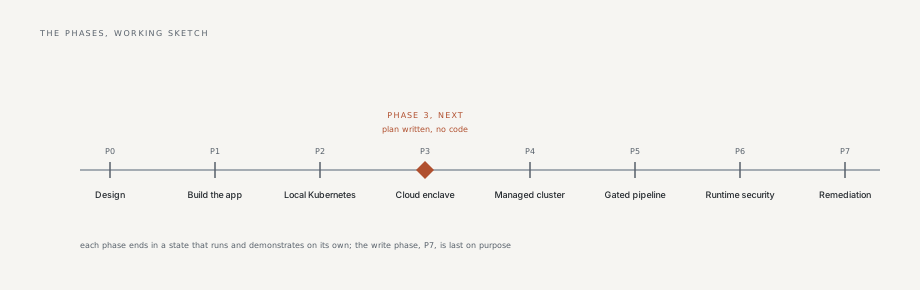
The program runs in eight phases, counted from zero to match the repositories. Phases 0 to 2 are complete. The Phase 3 plan is written in PHASE-3.md, and no Phase 3 code exists yet.
The phases:
- Design, before any code.
- The application: the observed half in twelve review-gated subphases, then the authorized half in fourteen more.
- Local Kubernetes: admission, network policy, identity.
- The cloud enclave as code.
- Managed Kubernetes.
- The security-gated pipeline, proven by a planted flaw.
- Runtime detection and response.
- Human-triggered remediation, last, because write access is earned.